HPLC Method for Analysis of Hyaluronic Acid on BIST A Column
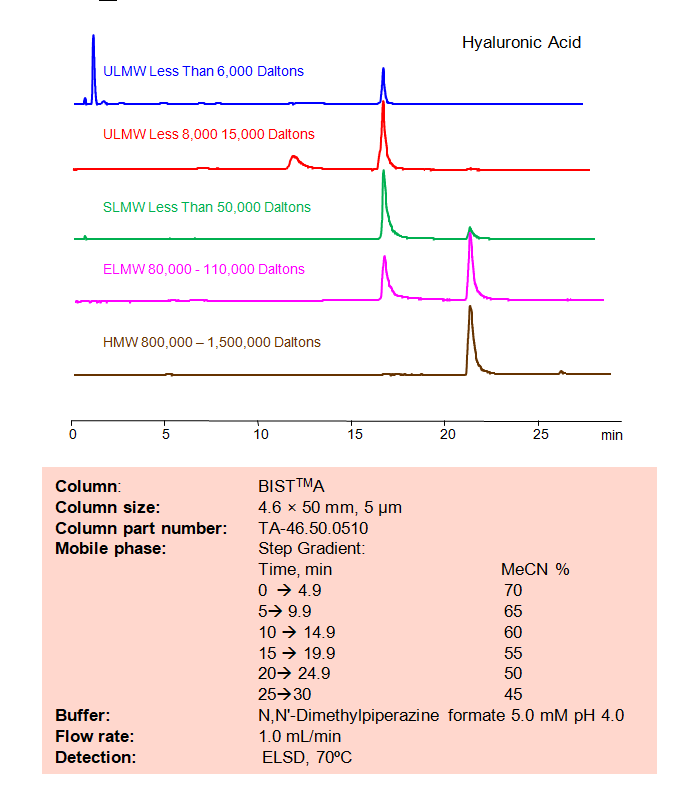
Separation type: Bridge Ion Separation Technology, or BIST™ by SIELC Technologies
Hyaluronic acid (HA) is a glycosaminoglycan, a type of molecule made up of long chains of sugar molecules. It’s found naturally in many parts of the body, including the skin, eyes, and joints. Due to its unique properties, hyaluronic acid is used in a variety of medical and cosmetic applications. Here are some key points to know about hyaluronic acid:
If you’re considering using products with hyaluronic acid or having procedures that involve HA, it’s essential to consult with a dermatologist or medical professional to ensure it’s the right choice for you.
Using SIELC’s newly introduced BIST™ method, however, hyaluronic acid can be retained, analyzed on a negatively-charged, cation-exchange BIST™ A column. There are two keys to this retention method: 1) a multi-charged, positive buffer, such as N,N’-Dimethylpiperazine (DMP), which acts as a bridge, linking the negatively-charged anion analytes to the negatively-charged column surface and 2) a mobile phase consisting mostly of organic solvent (such as MeCN) to minimize the formation of a solvation layer around the charged analytes. Other positively-charged buffers that can generate BIST™ include TMDAP, Calcium acetate, and Magnesium acetate. Using this new and unique analysis method, hyaluronic acid retained with high selectivity and great peak shape. This method can be detected and is compatible with ELSD, CAD, and Mass Spectrometry (LC-MS).
Methodenparameter
| Column | BIST A, 4.6 x 50 mm, 5 µm, 100 Å, dual ended |
|---|---|
| Mobile Phase | Step gradient MeCN |
| Buffer | N,N’-Dimethylpiperazine formate 5.0 mM pH 4.0 |
| Flow Rate | 1.0 mL/min |
| Detection | ELSD, the nebulizer and evaporator temperatures 70 °C, with a gas flow rate of 1.6 Standard Liters per Minute (SLM) (MS- compatible mobile phase) |