HPLC Method for Analysis of Guanylurea on Primesep 100 Column
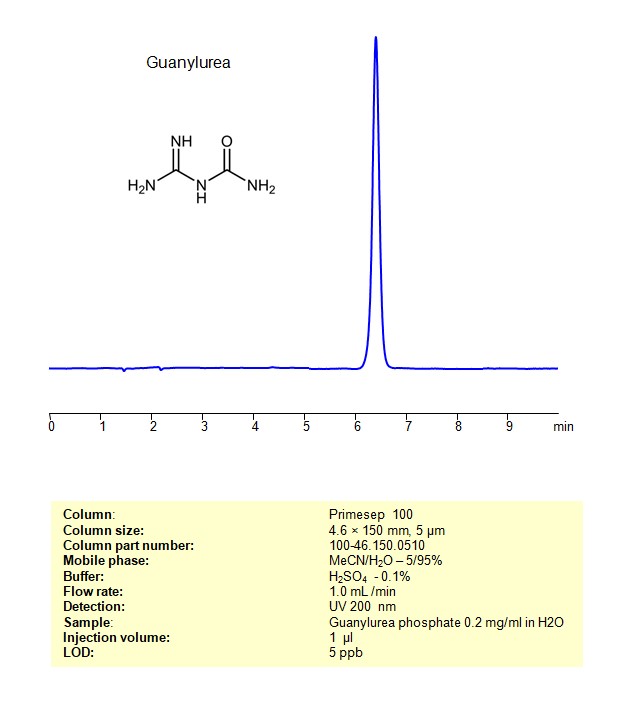
Guanylurea, also known as guanylurea phosphate or imidodicarbonimidic diamide, is a chemical compound with the formula C2H6N4O. It is derived from guanidine, a compound found in the urine of mammals, which is itself a derivative of urea.
The structure of guanylurea is characterized by a urea molecule (carbonyl group flanked by two amine groups) connected to an additional amine group. This structure imparts unique chemical properties to guanylurea, making it distinct from simpler urea.
In terms of its applications and uses:
Agriculture : Guanylurea can be used as a source of nitrogen in fertilizers, similar to urea. Its efficacy as a fertilizer comes from its ability to release nitrogen slowly into the soil, which can be beneficial for plant growth.
Chemical Synthesis : It may be used as an intermediate in the synthesis of other chemical compounds, particularly in pharmaceuticals and agrochemicals.
Research : In scientific research, guanylurea may be studied for its chemical properties and potential applications in various fields.
Methodenparameter
| Column | Primesep 100, 4.6 x 150 mm, 5 µm, 100 Å, dual ended |
|---|---|
| Mobile Phase | MeCN/H2O – 5/95% |
| Buffer | H2SO4 -0.1% |
| Flow Rate | 1.0 mL/min |
| Detection | UV 200 nm |
| Sample | Guanylurea phosphate 0.2 mg/ml in H2O |
| Injection Volume | 1 µl |