HPLC Method for Analysis of Gallic Acid in Bismuth Subgallate Tablets (Devrom) on Alltesta™
Separation type: Liquid Chromatography Mixed-mode
MS-compatible mobile phase
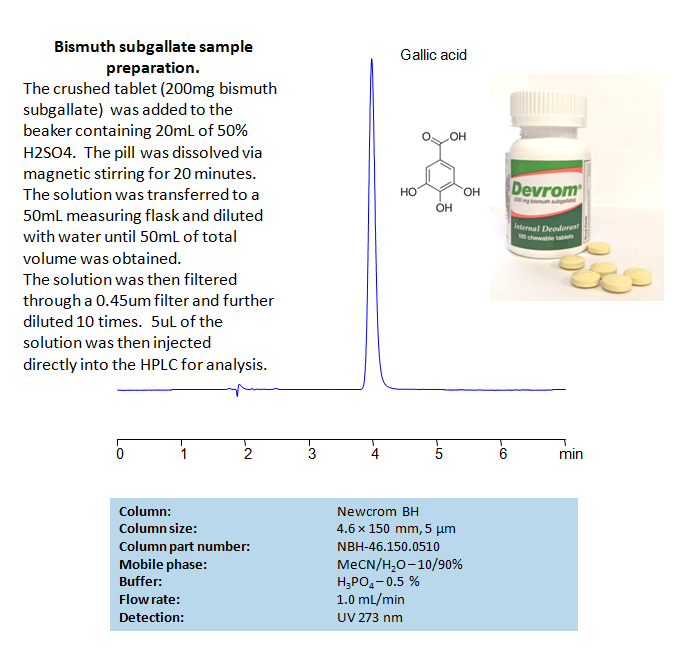
High Performance Liquid Chromatography (HPLC) Method for Analysis of of Gallic Acid in Bismuth Subgallate Tablets
Gallic acid is a naturally-occuring phenolic acid that was a key ingredient in European iron gall ink from its first discovery in the 12th century until the 19th century. In modern times, it’s heavy metal salt, Bismuth subgallate, known by its trade name Devrom, is known for its effects at deodorizing flatulence and stools. Gallic acid, extracted from Devrom tablets, can be retained and analyzed on a mixed-mode Newcrom BH column with a mobile phase consisting of water, Acetonitrile (MeCN), and Phosphoric acid (H3PO4). This analytical method can be UV detected at 200 nm with high resolution and peak symmetry.
The Newcrom columns are a family of reverse-phase-based columns. Newcrom A , AH , B , and BH are all mixed-mode columns with either positive or negative ion-pairing groups attached to either short (25 Å) or long (100 Å) ligand chains. Newcrom R1 is a special reverse-phase column with low silanol activity.
Methodenparameter
| Column | Newcrom BH, 3.2×100 mm, 100 Å |
|---|---|
| Mobile Phase | MeCN – 10% |
| Buffer | Formic acid – 0.05% |
| Flow Rate | 1.0 mL/min |
| Detection | UV 273 nm |