HPLC Method for Analysis of Curcuminoids in Turmeric Capsules on Newcrom R1 Column
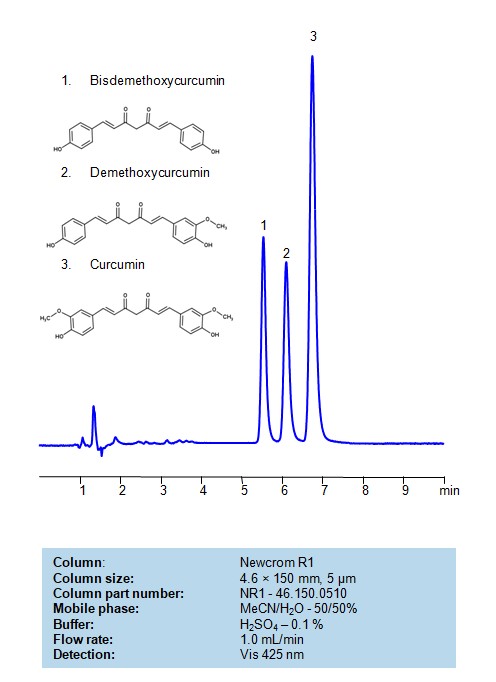
Separation type: Liquid Chromatography Reversed-phase
Turmeric is a yellow spice derived from the rhizomes of the plant Curcuma longa. It has been used for centuries in culinary and medicinal traditions, especially in Indian and Southeast Asian cultures. One of the main bioactive components responsible for many of turmeric’s potential health benefits is curcumin.
The curcumin content in turmeric varies depending on the source and preparation, but typically, dried turmeric powder contains about 2-5% curcumin by weight. This relatively low percentage is one reason why many curcumin supplements are made using extracts to provide a concentrated dose.
Curcumin is not a single compound but is rather a mixture of related compounds known as curcuminoids.
Curcuminoids are a group of polyphenolic compounds found in turmeric (Curcuma longa). They are responsible for the yellow color of the turmeric spice and are also the main bioactive components believed to be responsible for many of the potential health benefits of turmeric.
The three primary curcuminoids in turmeric are:
Methodenparameter
| Column | Newcrom R1, 0.5 x 150 mm, 5 µm, 100 Å, dual ended |
|---|---|
| Mobile Phase | MeCN/H2O – 50/50%, |
| Buffer | H2SO4 – 0.2% |
| Flow Rate | 1.0 mL/min |
| Detection | Vis 425 nm |