HPLC Method for Analysis of Bromoform on Newcrom R1 Column
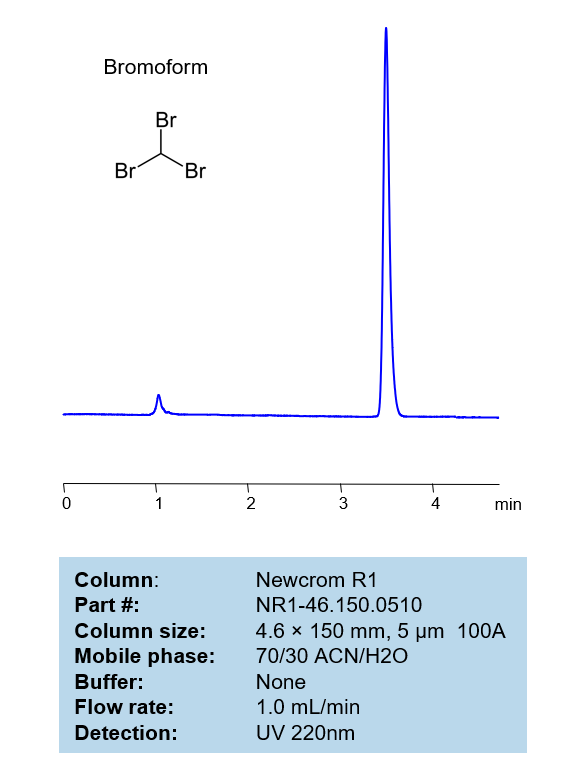
Separation type: Liquid Chromatography Mixed-mode
Bromoform is a heavy, volatile, colorless to yellow liquid, with a high refractive index, very high density, and sweet odor is similar to that of chloroform. It has the chemical formula CHBr3.
Bromoform is produced naturally in small quantities by algae and seaweed in the ocean, and it can also be synthesized by the haloform reaction of acetone (or ethanol) with sodium hypobromite, generated in situ by the reaction of sodium hydroxide with bromine.
In terms of uses, it was once used as a solvent, sedative and flame retardant, but now it is mainly used as a laboratory reagent.
One important thing to note is that bromoform is considered hazardous. It’s suspected of causing cancer, may cause damage to organs through prolonged or repeated exposure, and is harmful to aquatic life with long lasting effects.
Bromoform can be retained and analyzed on a reverse-phase Newcrom R1, 4.6 x 150 mm, 5 µm, 100 Å, dual ended column with a mobile phase consisting of water and Acetonitrile (MeCN). This analytical method can detect compounds with high resolution and peak symmetry using UV detection at 220 nm.
Methodenparameter
| Column | Newcrom R1, 4.6 x 150 mm, 5 µm, 100 Å, dual ended |
|---|---|
| Mobile Phase | MeCN/H2O -70/30% |
| Buffer | None |
| Flow Rate | 1.0 mL/min |
| Detection | UV 220 nm |
| Injection Volume | 3 µl |