Controlling Retention of Azinphos-ethyl on Primesep and Obelisc HPLC Columns
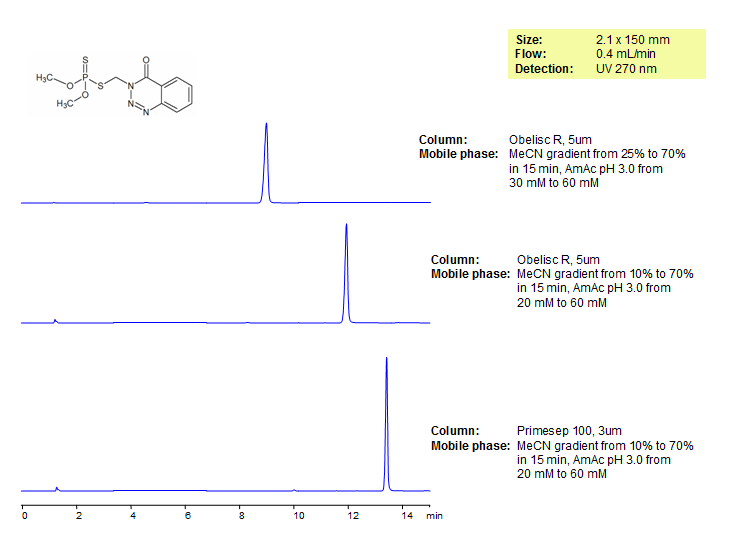
Azinphos-ethyl is a toxic pesticide in the organophosphate class. It is currently on the WHO (World Health Organization) hazard classification as class IB, highly hazardous. Azinphos-methyl, a compound with two less carbons is also a pesticide and considered a target pesticide by the EURL (European Union Reference Laboratory) for the EUPT-FF9 2015 a proficiency test for the analysis of a over a hundred pesticides. This compound was separated on two different mixed-mode columns, Primesep 100 and Obelisc R. Primesep 100 is a reverse phase column that contains embedded acidic ion-pairing groups, while Obelisc R retains with long hydrophobic chains and multiple ionic pairing groups on the surface. Method is LC/MS compatible and can be replicated to analyze dozens of other pesticides.
SIELC has developed the Obelisc™ columns, which are mixed-mode and utilize Liquid Separation Cell technology (LiSC™). These cost-effective columns are the first of their kind to be commercially available and can replace multiple HPLC columns, including reversed-phase (RP), AQ-type reversed-phase, polar-embedded group RP columns, normal-phase, cation-exchange, anion-exchange, ion-exclusion, and HILIC (Hydrophilic Interaction Liquid Chromatography) columns. By controlling just three orthogonal method parameters - buffer concentration, buffer pH, and organic modifier concentration - users can adjust the column properties with pinpoint precision to separate complex mixtures.
Methodenparameter
| Column | Primesep 100, 2.1×150 mm, 5 µm, 100 Å |
|---|---|
| Mobile Phase | Gradient MeCN – 10-70%, 15 min |
| Buffer | Gradient AmAc pH 3.0- 20-60 mM, 15 min |
| Flow Rate | 0.4 mL/min |
| Detection | UV, 270 nm |